Developing innovative technologies to monitor and mitigate atmospheric pollutants is a
significant research priority for the US Department of Energy (DOE) and the Office of
Environmental Management (EM). For this proposal, we plan to build off our current FY2023
MSIPP DOE EM award to continue investigating the use small unmanned aerial systems (sUAS)
to detect methane leaks. In addition, we plan to expand the project to include detection of
gaseous elemental mercury (GEM). Methane is a major concern because it is a potent
greenhouse gas. Many of these emissions are associated with past energy production activities
including abandoned oil and gas wells. Mercury atmospheric pollutant is of concern since it can
deposit onto the landscape and contaminate fish that pose a health risk to humans and wildlife.
Atmospheric GEM levels are an order-of-magnitude higher than pre-industrial levels due to
human activities. Some DOE facilities are contaminated with mercury due to historical activities,
such as the Y-12 complex at Oak Ridge National Laboratory.
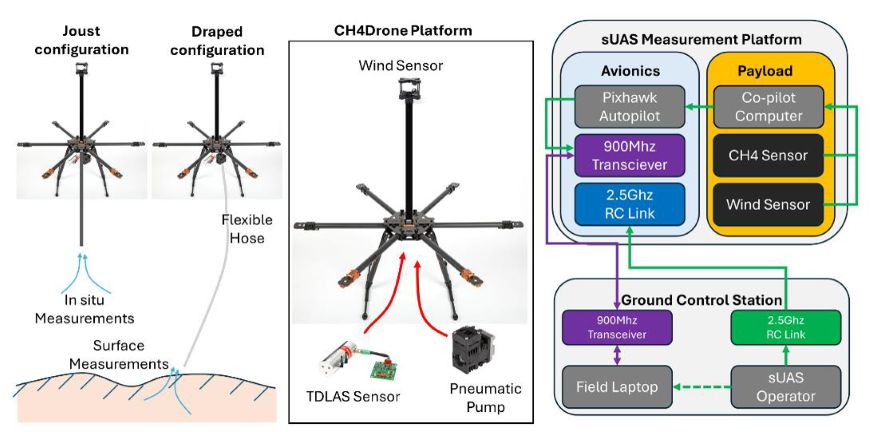
For our MSIPP FY2023 award, we are developing a low-cost and light-weight sUAS for
detection of small methane leaks based on the novel use of a tunable diode laser absorption
spectrometer. For our MSIPP FY2024 project, we plan to expand our project aims to include
testing a range of air sampling applications, including use of a joust intake configuration and a
draped intake configuration. Having the ability to sniff methane away from the drone and near
the source of emissions provides unique advantages in detecting emissions. A secondary aim is
to introduce students to the concept digital twin modeling and how it can be used to inform
methane leak detection and link to machine learning approaches to optimizing leak detection. A
third aim is to develop a light-weight GEM sensor platform compatible with sUAS operation for
GEM detection using an atomic absorption and/or fluorescence spectrometry sensor. We will
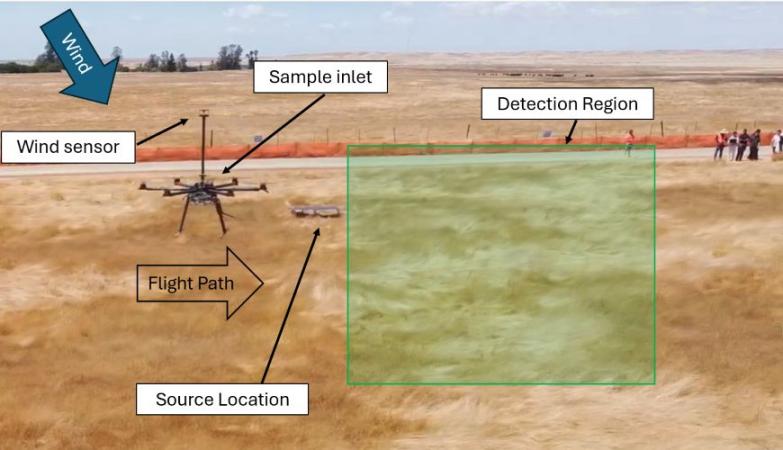
conduct a series of controlled release scenarios at the UC Merced Vernal Pools reserve adjacent
to the UC Merced campus. During flight campaigns, the leak source can be placed in different
locations and in different source modes (point vs diffuse) and different heights to test a range of
sampling configurations and approaches (e.g. joust and a draped configuration).
Our project will provide four undergraduate students with a one-year experiential STEM training
opportunity related to the use of sUAV for methane and mercury detection, while also
introducing them to the environmental cleanup mission of the DOE EM. Students will attend two
transformative trips aimed at engaging them with sUAS drone technology (DroneCamp,
California State University, Monterey) and the DOE EM environmental cleanup mission (MSIPP
Workshop in Augusta, Georgia). Note that our team has years of experience in recruiting and
training a diverse cohort of undergraduate students into the MSIPP EM program. Activities are
designed to provide research training, lab and field experiences, teamwork and career mentoring,
communications and writing practice, and engagement with professional scientists and engineers.
Two graduate students from our interdisciplinary Environmental Systems program and
Mechanical Engineering program will facilitate undergraduate research and mentoring, while
conducting research, all under the guidance of project investigators and a DOE project coach